
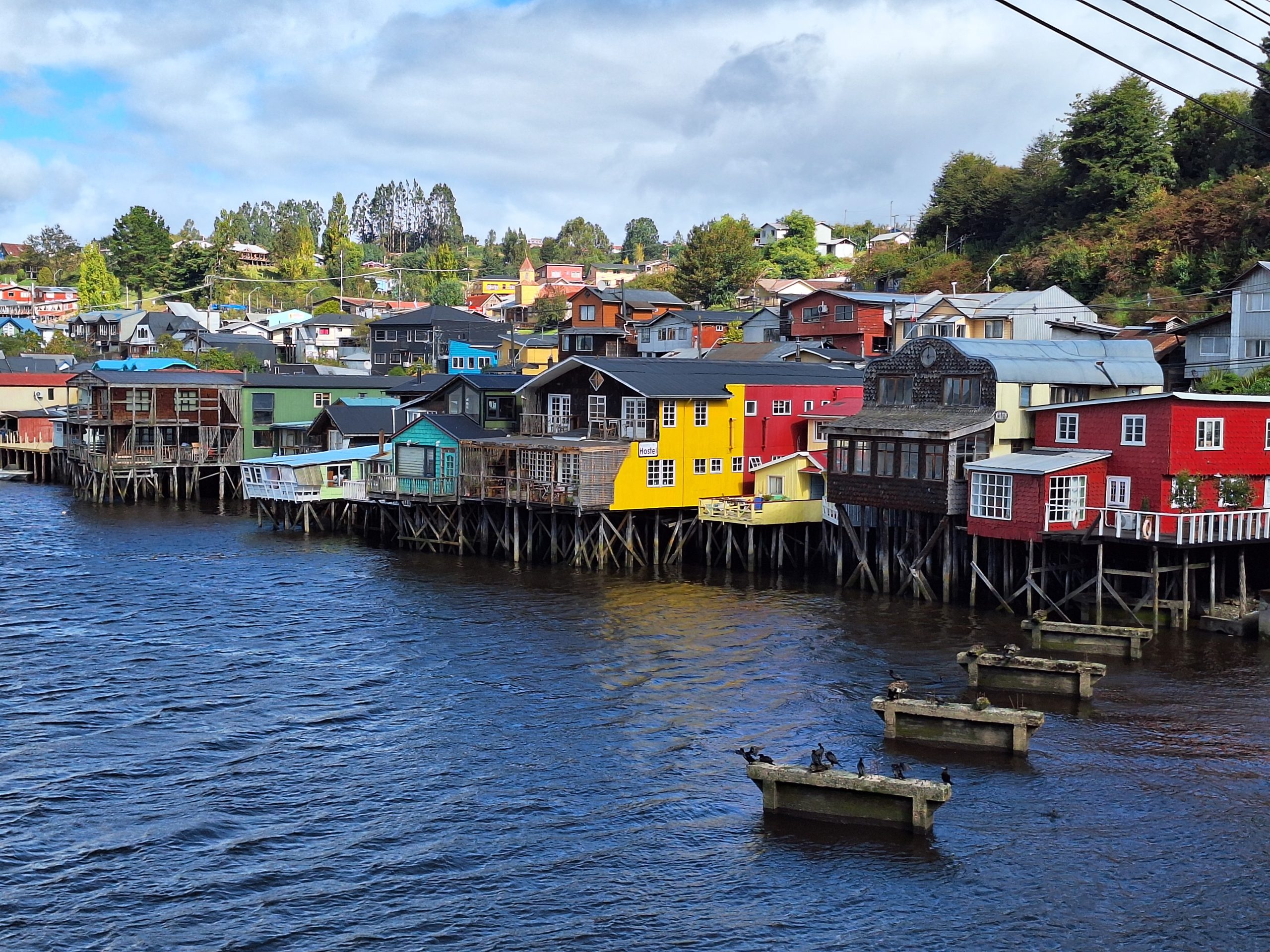
Chiloé doesn’t feel like a destination.
It feels like a story that you suddenly realize you’re inside.
Welcome to your complete guide to Chiloé: the most magical island in Chile
1. Why Chiloé feels different from the rest of Chile
Chiloé is a green, rainy archipelago in southern Chile, facing northern Patagonia. For centuries it was isolated from the mainland, and that created something unique:
- Colourful “palafitos” – houses on stilts over the tides in towns like Castro.
- More than 150 wooden churches, 16 of them UNESCO World Heritage Sites.
- An intense mythology – ghost ships like El Caleuche, sea spirits like La Pincoya, forest beings like El Trauco.
- Endless green: native Valdivian rainforest, misty hills, wild Pacific beaches.
Imagine waking up to the sound of rain on a wooden roof, walking past blue and yellow churches, eating curanto (typical food from Chiloé – Mix of seafood)* around a fire, and listening to stories about spirits that still “walk” the island. That’s Chiloé.
If you’re looking for something authentic, slow, and deeply local, keep reading – this island will get under your skin.
2. Where is Chiloé and how do you get there?
Chiloé is in Chile’s Lake District, south of Puerto Montt. The main island is called Isla Grande de Chiloé, with towns like Ancud, Castro, Dalcahue, Quellón and Cucao.
Getting to Chiloé
Chiloé is about 12-17 hours by car or bus from Santiago.
You have three main options:
1. By plane
- Direct flights from Santiago (SCL) to Castro’s Mocopulli Airport (MHC) – Several flights per week.
- Perfect if you want to save time and go directly into the island.
2. By flight + ferry
- Fly Santiago → Puerto Montt (PMC).
- Take a bus or car south to Pargua (about 1 hour).
- Cross the Chacao Channel by ferry to Chacao on Chiloé – about 30–35 minutes, running very frequently, 24/7 with several companies like Transmarchilay and Cruz del Sur.
3. By bus
- Direct overnight buses from Santiago to Ancud/Castro (around 16 hours).
- From Puerto Montt, buses cross on the ferry and continue to Ancud, Castro or Quellón.
Not sure which option fits your itinerary? Send us your dates on WhatsApp and we’ll tell you the simplest way to weave Chiloé into your Chile trip.
3. When is the best time to visit Chiloé?
Chiloé is green because it rains. A lot. The island has a rainy maritime temperate climate.
In simple terms:
- Best weather & most popular:
December to February (southern summer). Warmer, relatively drier, still fresh at night. - Great balance (our sweet spot):
October–November and March–April – fewer crowds, still decent weather, very atmospheric. It might be rainy. Relax and live the rain… - Winter (June–August):
More rain, more mud, more mystic fog… and almost no tourists. If you love solitude and don’t mind getting wet, it can be incredible.
if you already imagine yourself with a wool hat, hot coffee and the sound of rain on the roof, this place is probably your place.
4. How many days do you need?
To actually feel Chiloé:
- 3 days / 2 nights – minimum to see Castro, a bit of countryside and at least one national park.
- 5 days / 4 nights – ideal to slow down: visit rural communities, do forest walks, see penguins and enjoy long dinners around the fogón.
- 7+ days – perfect if you like slow travel and want to combine different areas (Castro, Cucao, Ancud, Quellón). You can stay for long time if you like to discover wild places, long walker, and love getting into nature.
We can help you choose depending on the rest of your Chile route.
5. The main areas of Chiloé (and what they feel like)
5.1 Castro – palafitos, markets and island life
Castro is the capital and “gateway” for many travellers. Here you’ll find:
- The famous palafitos – colourful houses on stilts over the water.
- The Cathedral of Castro, a bright yellow and purple church, UNESCO-listed. Every place you go, you will find a church.
- A lively local market where you see (and taste) the island’s potatoes, smoked fish and shellfish.
From Castro you can connect easily to rural agrotourism projects, traditional fogones (indoor fire kitchens), and small communities inland. Let us know what you expect and we will help you to find the best experience that fits with you.
5.2 Dalcahue, Achao & Curaco de Vélez – churches and channels
Across the channel from Castro:
- Dalcahue: craft market, wooden church and ferries to nearby islands. You must eat here. Its just amazing how amazing and how much happiness food can bring. This is the place to connect with that. Try a “Curanto”, “Caldillo de Congrio” and of course, potatoes.
- Achao: home to one of the oldest wooden churches in Chiloé. This is a small city to connect with the simple life.
- Curaco de Vélez: quiet town with coastal views. What really makes this place amazing, is the birdlife. This place has been made in honour to birds, so If you like observing them or a place just to disconnect for some time, this place is great for that.
This zone is perfect for a day of island-hopping, visiting churches and eating fresh seafood in a relax mood.
5.3 Ancud & the north – penguins and history
Up north:
- Ancud mixes history (old forts, viewpoints) with access to penguin colonies at Puñihuil, where Magellanic and Humboldt penguins nest side by side in season.
- The coastline is rugged, with big Pacific waves and incredible sunsets.
5.4 Cucao & the west coast – wild beaches and Chiloé National Park
On the wild side of the island:
- Cucao is a small village facing the Pacific, gateway to Chiloé National Park and “muelle de las almas”(Pier of Souls). If you want to stay longer and like adventure, you can get to one of the most beautiful beaches of the island, “cole cole beach”
- Here you’ll find:
- Long, empty beaches with black sand.
- Dunes, wetlands and coastal forests.
- Trails through remnants of native rainforest.
It’s the best area for those who want to feel small in front of nature.
5.5 Quellón & the south – end of the Pan-American and rural life
At the southern tip:
- Quellón is the “official” end of the Pan-American Highway and an active fishing port.
- Around it there are rural communities, beaches, bays and small islands where tourism is still very low-key – perfect for travellers searching for “from the inside” experiences.
6. The 10 experiences you should not miss in Chiloé
1. Stay in a rural home and share the kitchen
This is where the island’s heart really opens.
You might:
- Help prepare curanto, the traditional seafood-and-meat feast cooked in a hole in the ground or in a big pot.
- Taste homemade chicha, chapalele, milcao, sopaipillas with pebre, and freshly harvested potatoes.
- Listen to stories about the Caleuche – the ghost ship that appears in the fog – or La Pincoya, the sea spirit that brings abundance.
We work directly with families who have turned their farms and homes into small, community-based tourism projects – safe, authentic, and full of warmth.
2. Visit UNESCO wooden churches
Scattered across the island, many accessible on simple day trips:
- Walk into churches built entirely in wood, painted in bright colours, often with sea views.
- Each one has its own personality – some simple and quiet, others richly decorated.
If you’re into architecture, photography or just atmosphere, this will be a highlight.
3. Wander among palafitos at low and high tide
In Castro and other towns:
- At high tide, the houses seem to float.
- At low tide, you see the tall wooden legs and boats resting on the mud.
Plan to see both – it feels like two different cities.
This is important because the people in ancient times, were fed from the seafood left from this change.
4. Meet the penguins of Puñihuil (in season)
Between spring and summer, the islets of Puñihuil host colonies of Magellanic and Humboldt penguins, often alongside sea lions and cormorants.
A short boat trip (in good conditions) takes you close enough to watch them waddle, dive and argue in their tuxedos.
5. Hike in native rainforest
Chiloé’s rain creates a “green tunnel” feeling:
- Trails in Chiloé National Park, Tantauco Park and other reserves let you walk through dense, mossy forest with nalcas (giant rhubarb-like plants), myrtles and larch.
If you love forest bathing and the sound of rain on leaves, this is paradise.
6. Walk endless Pacific beaches
On the west coast:
- Kilometres of near-empty beach, dunes and driftwood.
- Perfect for contemplative walks, photography, and those who love raw, not-manicured landscapes.
7. Kayak through sunken forests and calm bays
Some areas of the island offer kayaking in flooded forests or quiet inlets, giving you a different perspective of the landscape and birdlife.
8. Taste the flavours of the island
Don’t leave without trying:
- Experiential Curanto (seafood cooken with hot stones). It’s a traditional and famous food as it is cooked in a very special way.
- Milcao and chapalele (potato-based breads).
- Fresh salmon, ceviche, and shellfish.
Food in Chiloé is not just about flavour – it’s about sitting for hours, talking, laughing, sharing stories.
9. Listen to myths by the fire
Ask locals about:
- El Trauco – a forest being blamed for unexpected pregnancies.
- La Pincoya – dancing on the shore to bless the sea with abundance.
- El Caleuche – the ghost ship carrying the souls of drowned sailors.
These stories are still alive; they’re part of everyday conversation.
10. Just… slow down
Chiloé is not a place only to “collect” attractions.
It’s also a place to:
- Read while you hear the rain.
- Watch clouds move over rolling hills.
- Drink a second (or third) cup of coffee because you’re actually relaxing.
7. Where to stay: feel the island from the inside
You’ll find:
- Palafito-style lodges in Castro,
- Small hotels and hostales in towns like Ancud, Castro and Quellón,
- And, our favourite, rural homes and agrotourism projects where you sleep surrounded by fields, animals, and forest.
Because we work directly with rural families and local proyects, we can create the perfect experience for you:
- It support the local economy,
- You’ll be safe and comfortable,
- And they make you feel like you truly “experienced” Chiloé, not just visited it.
9. Practical tips for your trip
- Pack for all seasons: waterproof jacket, warm layers, hat, but also sunglasses and lighter clothes. Weather changes fast.
- Shoes: something you don’t mind getting muddy – you will step on wet grass and dirt roads.
- Payments: cards are accepted in towns; in rural areas, bring some Chilean pesos in cash.
- Driving vs buses:
- Renting a car gives you freedom to explore small bays and rural roads.
- Buses connect main towns; for remote areas it’s easier if we coordinate transfers with local hosts. Buses sometimes are not that frequent. be aware of schedule before doing anything.
10. Ready to feel the magic of Chiloé?
If while reading this you:
- pictured yourself in a wooden house over the water,
- smelled the smoke of curanto and wet earth,
- felt that strange mix of calm + excitement in your chest…
…then Chiloé is already calling you.
Instead of losing hours comparing blogs, buses, ferries and weather charts, let us turn this feeling into a real itinerary – with local hosts, rural experiences and the right rhythm for you.
Write to us on WhatsApp and tell us:
- When you’re coming to Chile,
- How many days you have,
- If you travel solo, as a couple, with friends or family,
- And what kind of experiences move you the most (nature, food, culture, photography, slow travel…).
From there, we’ll design a custom Chiloé trip “from the inside”, and you just have to arrive.
No responses yet